
Oceaned: Simplifying the Path to Studying Abroad
Oceaned is a growing study abroad consultancy that needed its entire digital presence designed from scratch. The project spans three connected problems: a high-converting landing page, a content-driven blog built for organic search, and a full application management system that guides students through an eight-stage journey from initial consultation to visa approval.
01
The Brief and the Challenge
Oceaned is a study abroad consultancy that helps students find universities, navigate applications, secure scholarships, and get through visa processes. The service is genuinely valuable, but it was running almost entirely on manual communication: WhatsApp messages, spreadsheets, and back-and-forth emails to track applications that could span months.
The brief was to design the entire digital product from scratch. Not just a marketing site, but a full platform covering three distinct design problems at once: a public-facing presence that converts visitors into paying clients, a blog that earns organic traffic from students actively researching study abroad options, and a private application portal where students and staff can manage the entire process from first consultation to visa approval.
The real challenge was scope. Each of these three problems could be a project on its own. The design had to make them feel like one coherent product without letting the complexity of the application system bleed into the simplicity the landing page needed, and without letting the marketing goals compromise the clarity the student portal required.
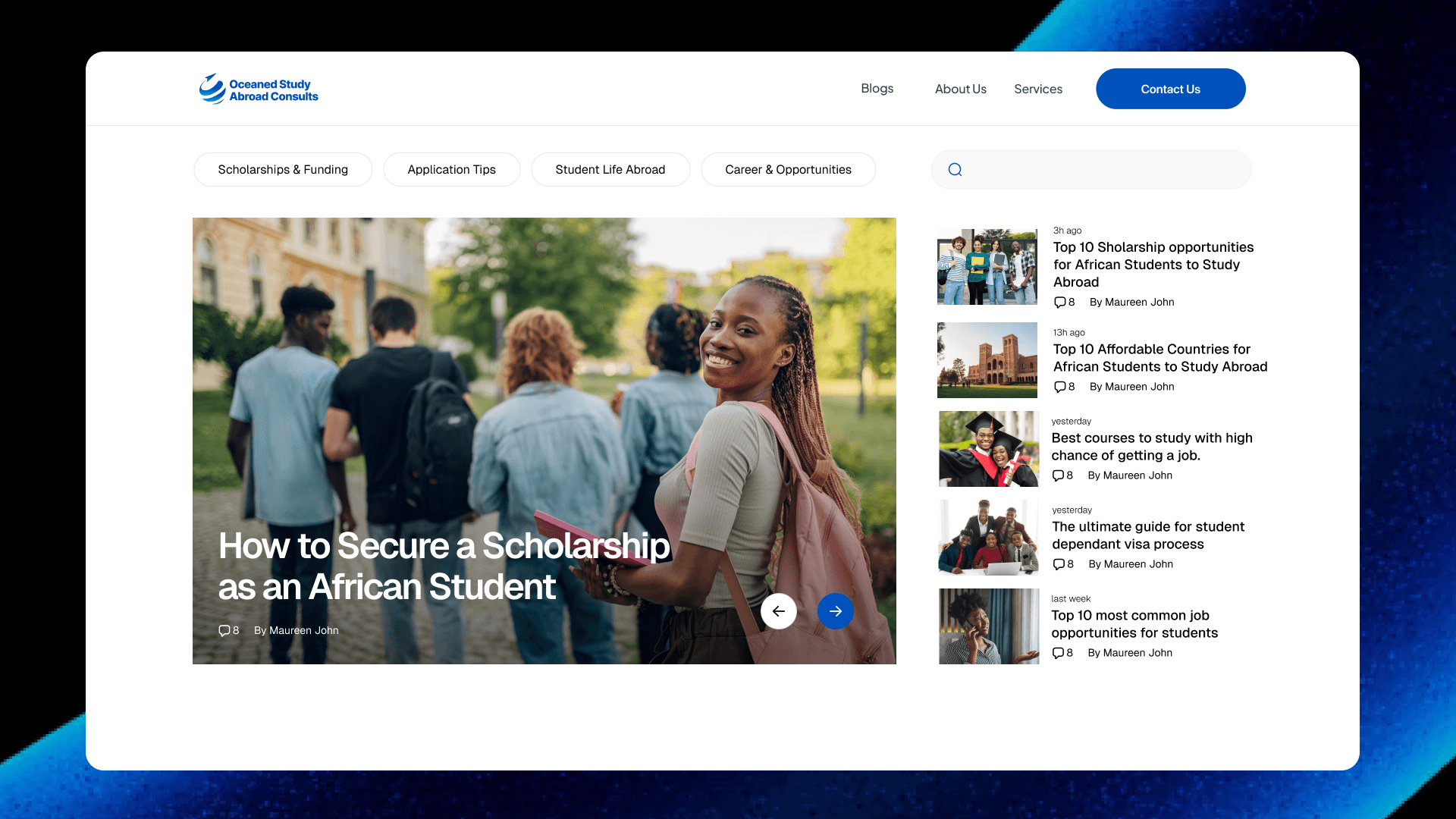
Oceaned blog and landing page design.
02
Designing for Conversion
The landing page had one job: make sure no visitor leaves without leaving something behind. Either they purchase a service, or they give Oceaned a way to reach them again. Most study abroad websites fail at this because they explain what the company does rather than showing what the student gets. We designed the page around outcomes, not features.
The content strategy started with understanding how students actually find Oceaned. Web search is the dominant acquisition channel: students searching for visa requirements, university comparisons, scholarship deadlines, or application tips. That research moment is the first touchpoint with the brand, often long before a student is ready to buy. The blog was designed to meet them there.
Each blog category maps to a real search intent: country guides, visa and immigration updates, scholarship announcements, school spotlights, and student stories. The goal was not just traffic but credibility. A student who reads three well-written articles about studying in Canada before they ever speak to a consultant already trusts the brand by the time they land on the services page.
The blog is not a marketing tool. It is a trust-building engine. Students who arrive through search already believe you know what you're talking about before they read a single word of your sales copy.
03
Mapping the Student Journey
Before designing a single screen for the application portal, we mapped the full student journey end to end. The process Oceaned runs is genuinely involved: it starts with an initial consultation, moves through payment and document collection, involves Oceaned researching the best school options based on the student's qualifications, preferences, and finances, and then progresses through application submission, offer management, and finally visa guidance.
That is eight distinct stages, each with its own tasks, documents, and decision points. And for most students using Oceaned, this is the first time they have ever done any of it. The design had to make the journey feel manageable at every step, with clear visibility into what was done, what was in progress, and what was coming next.
- Stage 1: Account Created: Admin creates the student account after the initial consultation. The student receives login credentials and sees their application begin.
- Stage 2: Documents Uploaded: The student submits required documents: passport, academic transcripts, CV, statement of purpose, recommendation letters, and any additional materials.
- Stage 3: Under Review: Oceaned's team reviews the documents, verifies information, and begins researching the best school options based on the student's profile.
- Stage 4: Recommendation Issued: Oceaned presents a curated shortlist of schools and programs tailored to the student's qualifications, preferences, and budget. The student reviews and confirms.
- Stage 5 to 8: Application Through Visa: Oceaned submits the applications, manages offer responses, guides the student through acceptance and payment, and walks them through the full visa application process.
04
The Student Dashboard
The dashboard is where eight stages of complexity had to disappear into something clear and calm. We built the design around a visual progress timeline that makes the application lifecycle concrete rather than abstract. Students can see exactly which stage they are in, which stages are complete, and what sits ahead.
Alongside the timeline, a document checklist gives real-time status on every file: uploaded, pending review, or approved. Payment status, active notifications, and the recommendation from the Oceaned team are all surfaced in the same view. The goal was to eliminate the need to chase the consultant for an update, because the answer is always on the screen.
The document upload flow required particular care. Submitting a passport or academic transcript during a high-stakes application process is not a casual interaction. We designed it with clear file validation, explicit upload confirmation, and step-by-step status feedback so students always knew their materials had landed safely and were being reviewed.
Student application dashboard — progress timeline, document checklist, and payment status in one view.
05
The System Behind the Scenes
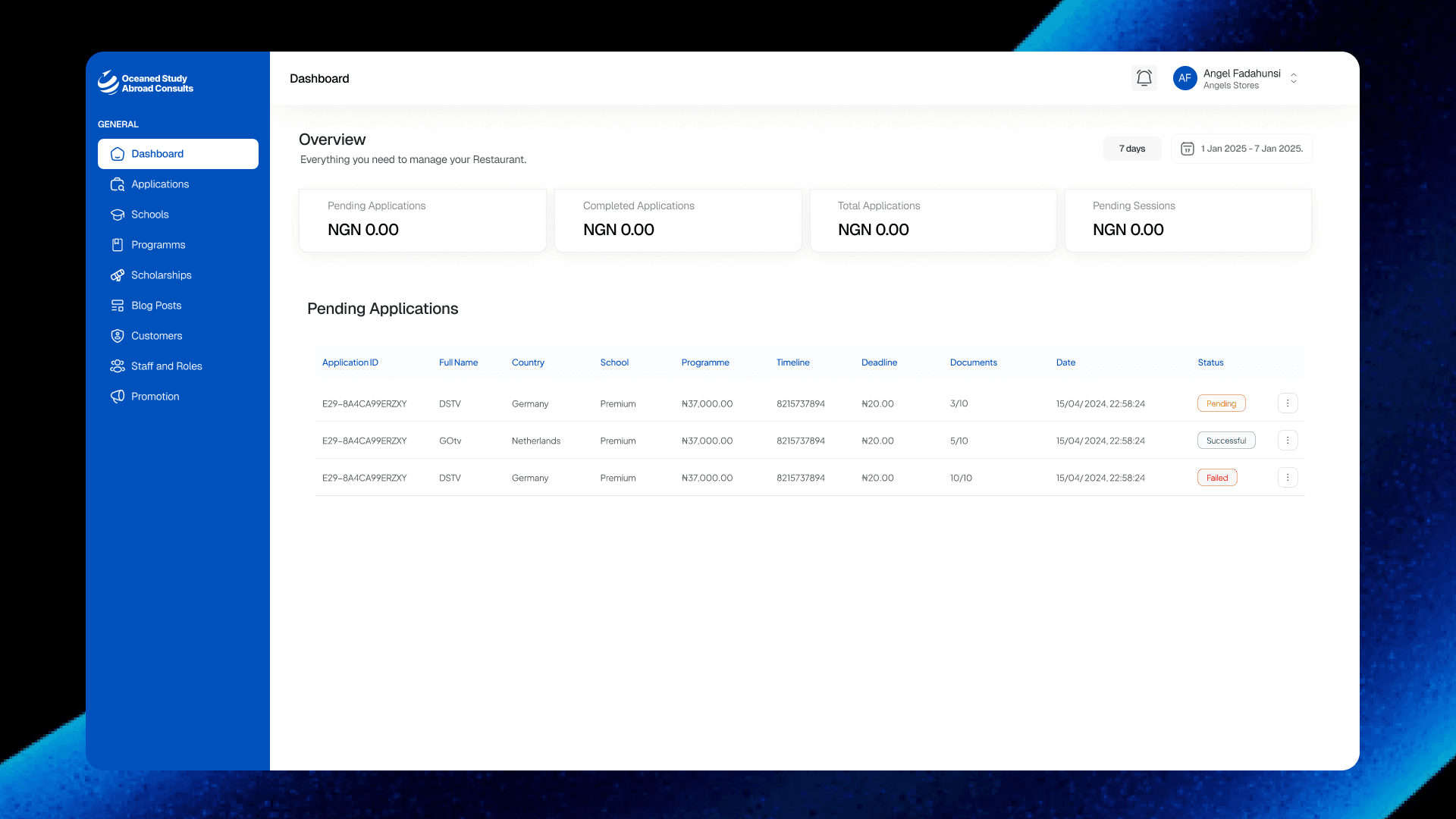
The admin panel is where the Oceaned team manages everything: tracking student applications, issuing school recommendations, publishing blog content, adding schools and programs to the catalogue, and handling payment records. Four distinct admin roles keep the interface lean for each team member: super admins who manage the whole platform, content editors who own the blog, application managers who handle student progress, and finance admins who track payments.
The school management system was one of the more interesting design challenges in the entire project. Oceaned's value to students depends on the quality of the schools they can recommend. Each school in the system has multiple degree programs, and each program carries its own deadlines, tuition fees, language requirements, intake periods, and available scholarships. The admin interface had to make managing this catalogue straightforward for staff who are first and foremost consultants, not data entry operators.
The scholarship module adds another layer: a filterable, searchable database of funding opportunities that students can browse by country, degree type, field of study, and deadline. Push notifications remind students of approaching deadlines. This module is built for mobile first, because scholarship hunting tends to happen in pockets of time, on the go, not at a desk.
Designing the admin panel with the same intentionality as the student-facing product was the decision that made the whole system coherent. When the staff tools are clear and efficient, the student experience improves automatically because consultants spend less time managing software and more time managing applications.